Side income feels like free money until April. At a regular job your employer withholds tax and pays half of your Social Security and Medicare. On freelance or gig income in the U.S., nobody withholds anything and you pay both halves yourself. Setting money aside as it comes in is what keeps a good side income from turning into a tax bill you can't pay.
What is self-employment tax?
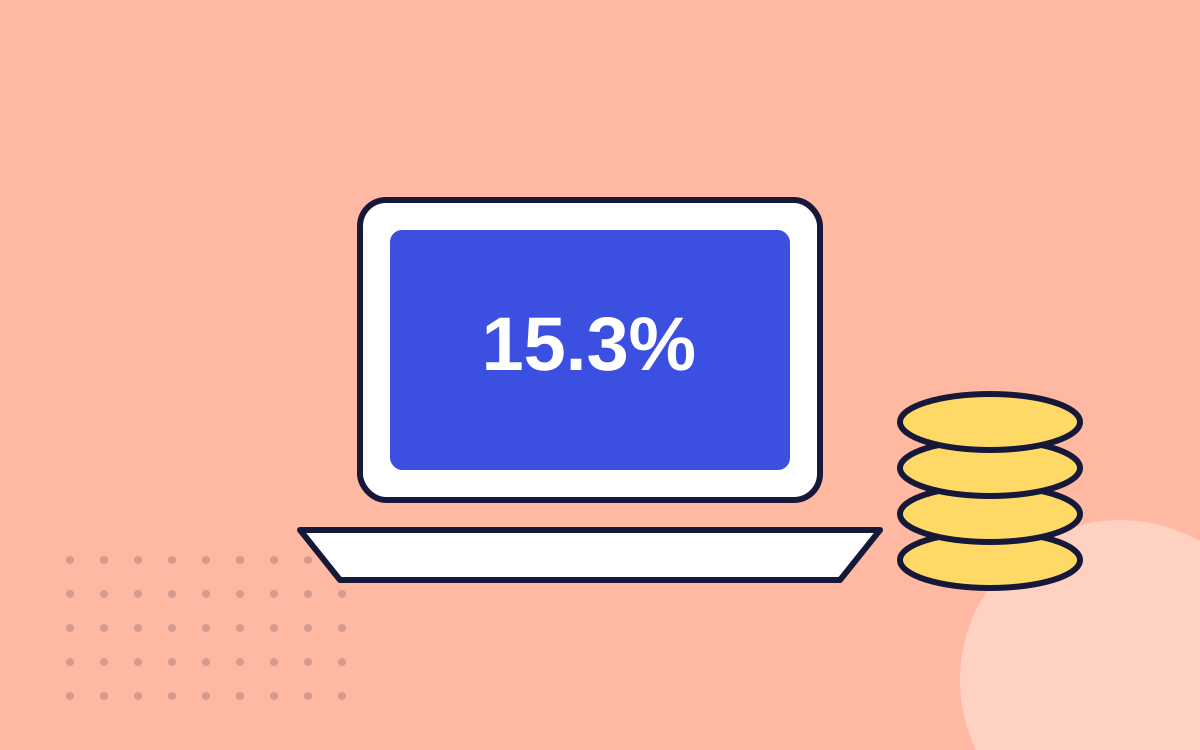
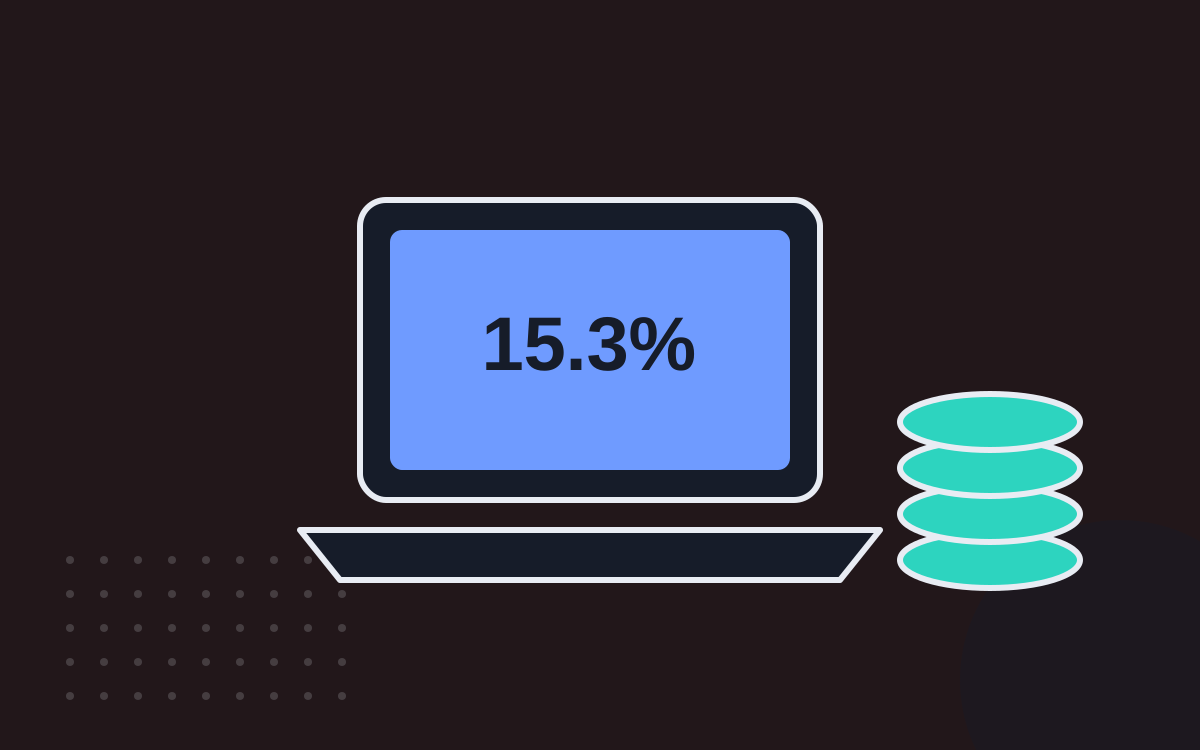
- Rate: 15.3%, made of 12.4% for Social Security and 2.9% for Medicare (IRS).
- On what: generally 92.35% of your net earnings from self-employment, meaning income minus business expenses.
- When it applies: you usually owe it if net self-employment earnings are $400 or more for the year.
- The cap: the Social Security part stops once wages plus self-employment earnings reach the wage base, $184,500 for 2026 (SSA). Most side earners are nowhere near it. The base rises to $192,300 for 2027; see our 2027 wage base explainer.
- The deduction: you can deduct half of your self-employment tax when you work out your adjusted gross income.
Self-employment tax comes on top of regular income tax on the same money. It is also why a contract paid on a 1099 is worth less than a job paying the same rate; our W-2 vs. 1099 guide runs the numbers.
A worked example: $500 a month
Say a side gig brings in $500 a month after expenses, or $6,000 a year. Self-employment tax is $6,000 × 92.35% × 15.3% = $848. Income tax depends on your bracket, so here are three:
| Marginal federal rate | Self-employment tax | Income tax | Total | Share of side income | Set aside per month |
|---|---|---|---|---|---|
| 10% | $848 | $558 | $1,405 | 23.4% | $117 |
| 12% | $848 | $669 | $1,517 | 25.3% | $126 |
| 22% | $848 | $1,227 | $2,075 | 34.6% | $173 |
So a reasonable habit is to move 23%–35% of each side payment into a separate savings account the day it arrives, more if your state has an income tax.
Do you need to pay estimated tax each quarter?
The IRS says individuals generally need to make estimated tax payments if they expect to owe $1,000 or more when they file. You can usually avoid an underpayment penalty by paying at least 90% of this year's tax or 100% of last year's, whichever is smaller. The due dates:
| Income earned | Payment due |
|---|---|
| January 1 – March 31 | April 15 |
| April 1 – May 31 | June 15 |
| June 1 – August 31 | September 15 |
| September 1 – December 31 | January 15 of the next year |
If you also have a regular job, a simpler route can be raising the tax withheld from your paycheck to cover the side income. Our guide to reading your pay stub shows where that withholding appears.
Will you get a 1099 for side income?
- Form 1099-NEC reports payments from a business client to you as a non-employee. For tax years beginning after 2025, the reporting threshold rose to $2,000, and it may be adjusted for inflation from 2027 (IRS).
- Form 1099-K comes from payment apps and online marketplaces. After the One, Big, Beautiful Bill, they only have to send one when your payments for the year exceed $20,000 and number more than 200 (IRS).
Higher thresholds mean many side earners will get fewer forms or none. That changes the paperwork, not the tax. You still report the income, so keep your own record of every payment.
Which expenses lower the tax bill?
Both taxes are worked out on net earnings, so legitimate business expenses reduce both. A few that side earners often miss:
- Business driving: the IRS standard rate for 2026 is 72.5 cents a mile. Driving between deliveries or to a client counts; your normal commute to a regular job doesn't. Log the date, miles and purpose.
- A home office: with the IRS simplified method you can deduct $5 per square foot for up to 300 square feet (up to $1,500), if the space is used regularly and only for the business.
- Tools and software you buy for the work, and the business share of your phone and internet.
- Platform and payment fees taken out before the money reaches you.
As a quick example, 1,000 business miles in 2026 at the standard rate is $725 off your net earnings, which also trims the self-employment tax by about $102.
At tax time
- Schedule C works out your profit: income minus business expenses.
- Schedule SE works out the self-employment tax on that profit.
- Both feed into your normal Form 1040, along with any estimated payments you made during the year using Form 1040-ES.
A separate bank account for the side income makes all three steps much easier: every payment in and every expense out is already in one place.
Assumptions: $6,000 of net side income in a year, the federal marginal income tax rates shown, half of self-employment tax deducted, no other deductions or credits, no state tax.
Common questions
Do I owe self-employment tax on a small side income?
Usually only once net self-employment earnings reach $400 for the year. Income tax is a separate question: side income generally counts toward your taxable income even below that level.
I didn't get a 1099. Do I still report the income?
Yes. The forms are how platforms and clients report payments to the IRS; your duty to report the income doesn't depend on whether a form arrives.
Do I need an LLC to start a side business?
No. If you work for yourself without forming a company you're a sole proprietor by default. An LLC can help with liability, but on its own it doesn't change how self-employment tax works for a one-person business.
Is my side income a hobby or a business?
It depends on whether you run it to make a profit: keeping records, trying to improve results and putting in regular time all point to a business. The difference matters for which expenses you can deduct.
Sources
- IRS, Topic no. 554: Self-employment tax irs.gov
- IRS, Self-employment tax (Social Security and Medicare taxes) irs.gov
- IRS, Estimated taxes irs.gov
- IRS, Estimated tax due dates for individuals irs.gov
- Social Security Administration, Contribution and benefit base ssa.gov
- IRS, Instructions for Forms 1099-MISC and 1099-NEC irs.gov
- IRS, IRS issues FAQs on Form 1099-K threshold under the One, Big, Beautiful Bill; dollar limit reverts to $20,000 (Oct 23, 2025) irs.gov
- IRS, 2026 business standard mileage rate (IR-2025-128) irs.gov
- IRS, Simplified option for home office deduction irs.gov
This article is general education, not personal financial advice. Figures in worked examples are calculated from the assumptions stated with them and are not forecasts.
Get the next guide by email
The Payday Note every Thursday, plus the free Raise Kit.