A raise usually arrives as one number: a new salary, a new hourly rate, or a percentage in an email. To know what it's actually worth, you need to turn that number into the other forms: a percentage you can compare, a yearly amount you can plan with, and a figure you'll see on each paycheck.
How do you calculate a raise percentage?
Subtract your old pay from your new pay, divide by the old pay, and multiply by 100. Always divide by the old number; that's what the raise is measured against.
Say your salary goes from $50,000 to $52,000. The increase is $2,000, and $2,000 ÷ $50,000 = 4.0%. The same formula works for hourly pay, weekly pay or a single paycheck, as long as old and new are measured the same way.
Going the other way, from a percentage to dollars, is just multiplication: old pay × (1 + raise). A 3% raise on $50,000 is $50,000 × 1.03 = $51,500, or $1,500 more a year.
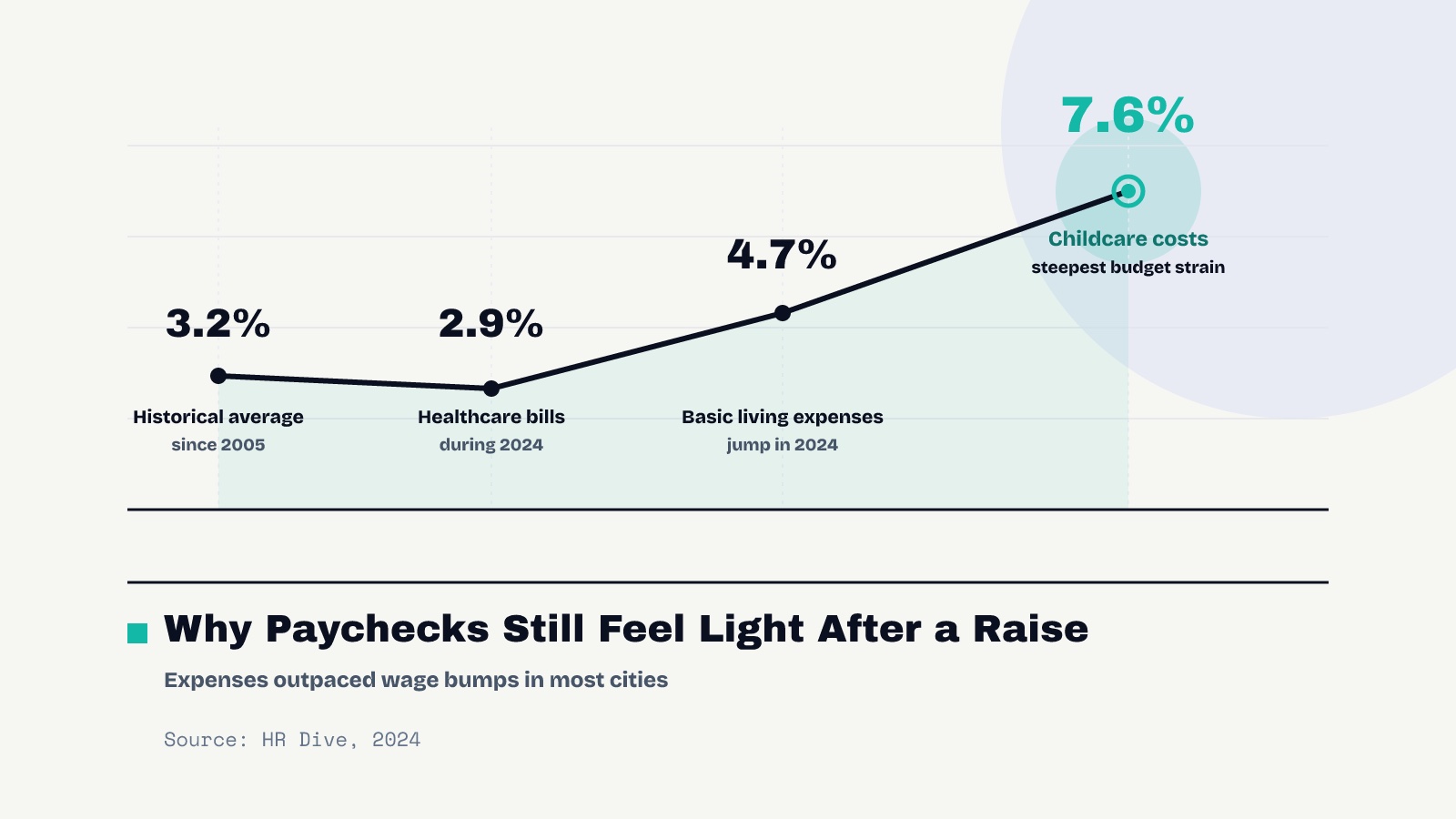
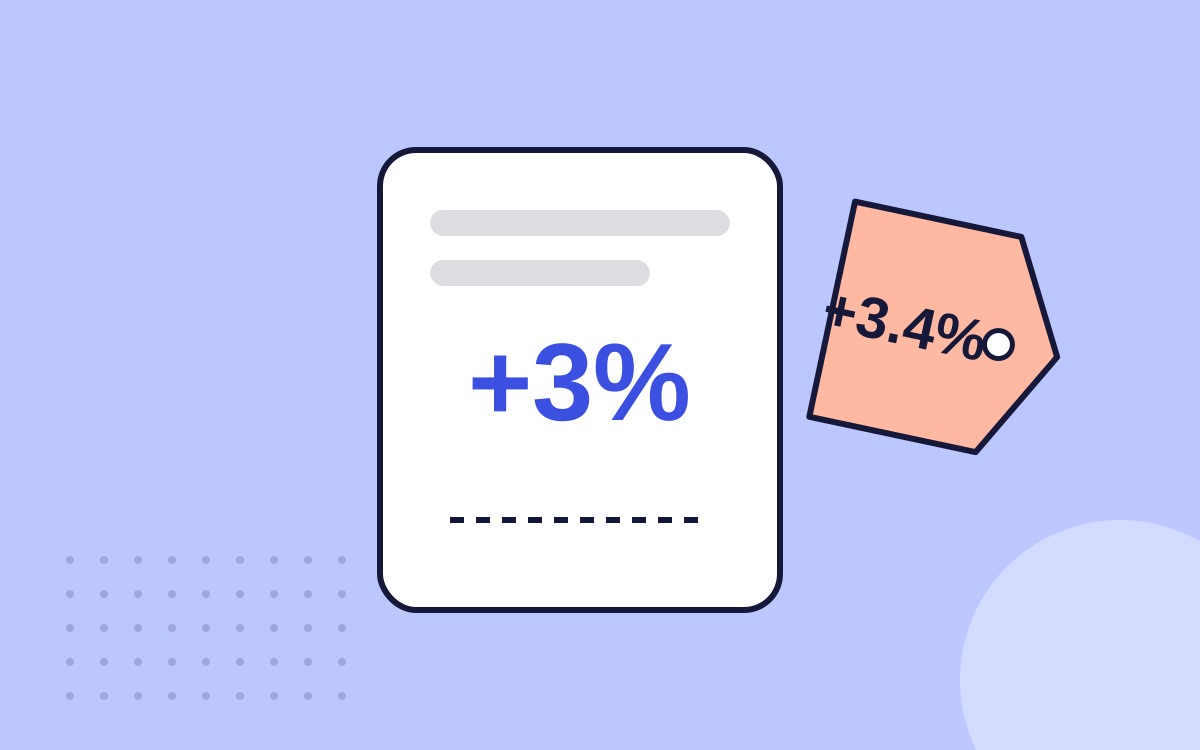
For context, Mercer's March 2026 survey of 756 U.S. employers found that the average merit increase actually paid this year was 3.1%, and total increases averaged 3.4%. WTW's January 2026 survey had projected salary increase budgets of 3.4%. These averages include people who got no raise, so those who did got somewhat more on average.
How do you convert an hourly raise to annual pay?
Multiply the raise per hour by the hours you're paid for in a year. A full-time schedule is usually counted as 40 hours a week × 52 weeks = 2,080 hours.
If your rate goes from $20.00 to $21.00, that's a 5% raise and about $2,080 a year before tax. If you work 30 hours a week instead, use 30 × 52: the same $1 is worth $1,560 a year. Hourly workers with uneven schedules get a more honest number from their average hours over the last few months.
To go from a salary raise back to an hourly figure, divide by 2,080: a $1,500 raise is about $0.72 an hour. Small hourly raises are bigger than they sound in percentage terms, especially at lower rates:
| Raise per hour | On $18.00/hr | Per year, full time |
|---|---|---|
| $0.50 | 2.8% | $1,040 |
| $1.00 | 5.6% | $2,080 |
| $1.50 | 8.3% | $3,120 |
| $2.00 | 11.1% | $4,160 |
If your total pay includes regular overtime, the raise also lifts your overtime rate, since it's 1.5 times your regular rate. Our guide to overtime pay shows how that works.
How do you work out the raise you need, or two raises in a row?
Use the same formula backward. If you earn $50,000 and want $55,000, the raise you need is ($55,000 − $50,000) ÷ $50,000 = 10%. Knowing the percentage helps you see whether a request is in the usual range or closer to a promotion.
Two raises in a row don't simply add up, because the second is a percentage of the already-higher pay. A 3% raise followed by a 4% raise takes $50,000 to $53,560, a total increase of 7.12%, not 7%. To combine raises, multiply (1 + first) × (1 + second) and subtract 1.
What does a raise add to each paycheck?
Divide the yearly raise by your number of pay periods: 52 if you're paid weekly, 26 every two weeks, 24 twice a month, 12 monthly. Then allow for tax. The extra dollars are taxed at your marginal rate, not your average rate.
Two parts of that are fixed for most employees: 6.2% Social Security and 1.45% Medicare, 7.65% together (IRS). Income tax depends on your bracket, your state and your W-4. For a rough example we use an assumed 15% combined federal and state rate, for a total drag of about 22.7%:
| How often you're paid | Extra gross per check | Extra after rough tax |
|---|---|---|
| Weekly | $28.85 | $22.31 |
| Every two weeks (biweekly) | $57.69 | $44.63 |
| Twice a month (semimonthly) | $62.50 | $48.34 |
| Monthly | $125.00 | $96.69 |
Paid every two weeks, a $1,500 raise shows up as about $44.63 more take-home per check. That's why raises often feel smaller than they are. Pre-tax deductions set as a percentage of pay, like a 401(k) contribution, also rise, which lowers take-home a little more but isn't money lost. Our guide to reading your pay stub shows where to check each line.
How does a raise compound over 5 to 10 years?
A raise is paid every year from now on, and every later percentage raise is calculated on the higher base. A one-time bonus is paid once. Take a 3% raise on $50,000 versus a $1,500 bonus, the same amount in year one. Assume pay then grows 3.1% a year, Mercer's 2026 average merit increase:
| Extra pay that year | Extra pay added up | One-time bonus | |
|---|---|---|---|
| Year 1 | $1,500 | $1,500 | $1,500 |
| Year 5 | $1,695 | $7,980 | $1,500 |
| Year 10 | $1,974 | $17,275 | $1,500 |
After five years the raise has paid $7,980; after ten, $17,275, $15,775 more than the bonus. That's also why a few thousand dollars at the start of a job matters so much; see what a $3,000 higher starting salary is worth. Retirement matches set as a percentage of salary grow with a raise too, which a bonus often doesn't count toward.
A bonus still has its uses. It arrives as a lump sum, and a large one can beat a small raise for several years. If an employer offers a choice, compare the bonus with the raise's added-up total over the time you expect to stay.
What should you check before you celebrate?
- Compare it with prices. A raise below inflation buys less than last year's pay. Our raise vs. inflation check takes two minutes.
- Confirm the effective date. If the raise starts mid-pay period, the first check may show only part of it.
- Look at the first new stub. Gross pay per period should rise by the yearly raise ÷ your number of pay periods.
- Compare with the market. If your raise sits well below what job switchers are getting, that's useful at your next review.
Assumptions: a $50,000 salary and a 3% raise; full time = 2,080 paid hours a year; tax drag = 7.65% Social Security and Medicare plus an assumed 15% combined income-tax rate; later raises of 3.1% a year with no job changes. Pre-tax deductions are left out. General information, not tax advice.
Common questions
How do I calculate a 3% raise?
Multiply your current pay by 0.03 to get the increase, or by 1.03 to get the new pay. On $50,000 that's $1,500 more, for a new salary of $51,500.
How do I turn an hourly raise into a yearly amount?
Multiply the raise per hour by the hours you work in a year. Full time is usually counted as 40 hours × 52 weeks = 2,080 hours, so each $1 an hour is about $2,080 a year before tax.
Why is the raise on my paycheck smaller than I expected?
Your paycheck shows the raise divided by the number of pay periods, minus Social Security, Medicare and income tax on the extra dollars. Retirement contributions set as a percentage of pay also grow with a raise.
Is a bonus or a raise better?
Dollar for dollar, a raise usually is, because it repeats every year and later percentage raises are calculated on top of it. A bonus is paid once. A large bonus can still beat a small raise in the short run.
What is a typical raise in 2026?
Mercer's March 2026 survey of U.S. employers found an average merit increase of 3.1% and total increases averaging 3.4%, including employees who got no increase. Your own raise depends on your employer, role and performance.
Sources
- Mercer, Annual increases paid out as expected (QuickPulse US Compensation Planning Survey, April 2026) imercer.com
- HR Dive, Salary budgets stable in 2026 at 3.4%: WTW (January 2026) hrdive.com
- IRS, Topic no. 751: Social Security and Medicare withholding rates irs.gov
This article is general education, not personal financial advice. Figures in worked examples are calculated from the assumptions stated with them and are not forecasts.
Get the next guide by email
The Payday Note every Thursday, plus the free Raise Kit.