You may have received a pay bump recently, yet your bank account balances look no larger at the end of the month. A new study shows that everyday essentials climbed faster than wages across most major metropolitan markets. This guide breaks down what happened to purchasing power and how you can assess your true compensation.
What Changed Across Urban Job Markets
When you look at your pay stub after a raise, the gross pay line shows a larger number. You expect that extra money to give you breathing room. However, widespread analysis shows that higher gross pay did not translate into greater financial security for millions of workers.
HR Dive reported that rising employee wages across US metro areas continued to fall behind higher living expenses. The findings come from a study by the Ludwig Institute for Shared Economic Prosperity, which evaluated worker spending power across major US metropolitan markets. The study found that household purchasing power fell in 61 percent of the 56 largest urban areas during 2024 for lower- and middle-income families.
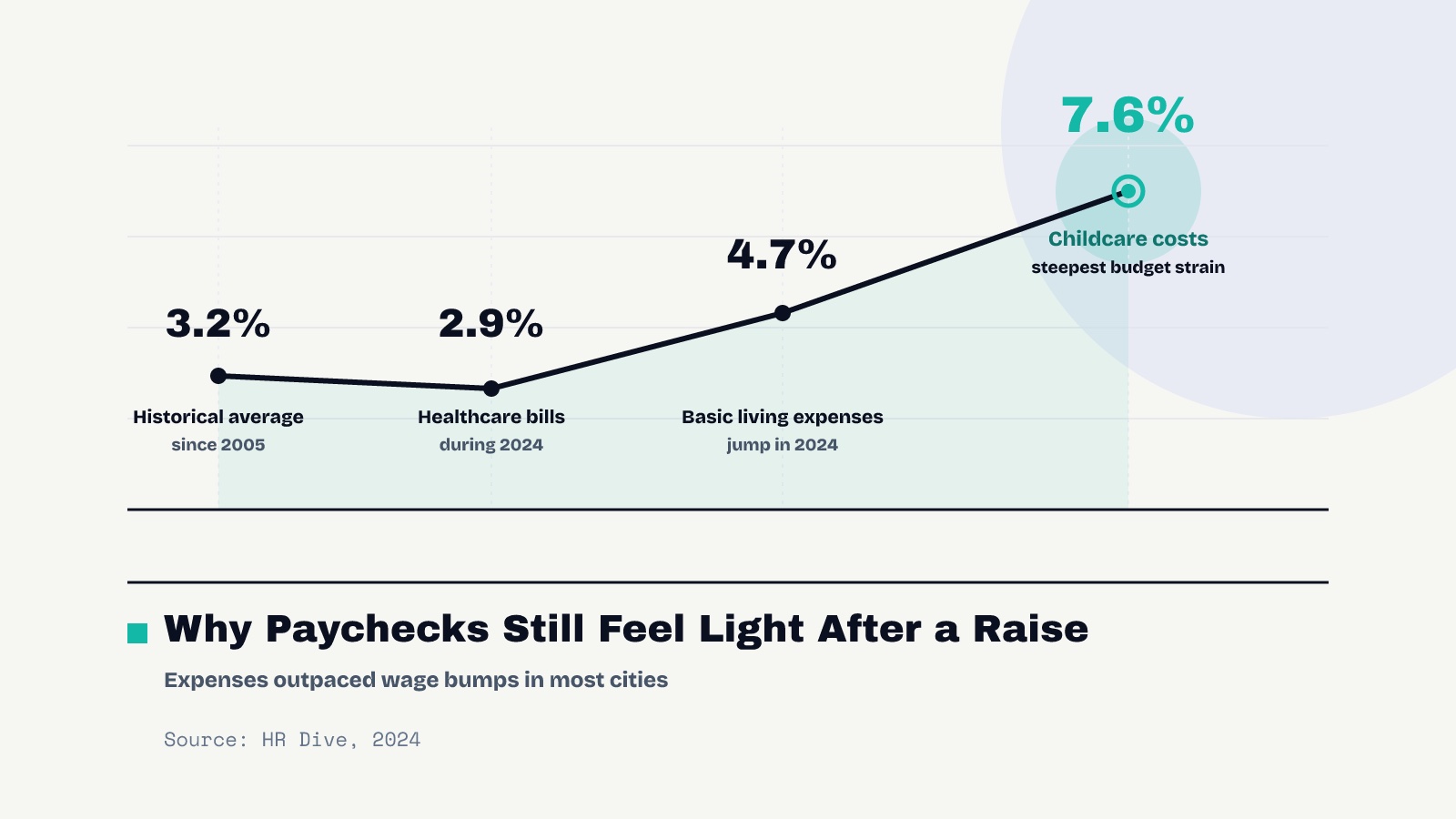
In those cities, nominal pay bumps failed to keep pace with living costs. Even though employers handed out salary bumps and hourly increases, basic living expenses rose 4.7 percent during 2024. That increase was not a minor bump. The 4.7 percent jump in living expenses during 2024 outpaced the 3.2 percent historical annual average recorded since 2005.
The research highlights that critical household expenditures drove the widening divide between nominal paycheck increases and actual everyday living expenses. When the necessities you cannot avoid get more expensive so quickly, a standard annual raise can leave you with less real purchasing power than you had twelve months earlier.
The Critical Expenses Squeezing Household Budgets
Inflation is never uniform across every item in your shopping cart. Headline numbers often blend discretionary purchases like electronics with non-negotiable monthly obligations. For working families, non-negotiable expenses are the ones that dictate whether a paycheck stretches to the end of the month.
The Ludwig Institute analysis revealed that childcare costs expanded by an average of 7.6 percent, representing one of the steepest drivers of household budget strain. For any working parent, a 7.6 percent jump in childcare eats away a standard pay bump almost immediately. Even if your boss granted a modest bump, higher daycare rates or after-school care tuition absorb that extra cash before it hits your savings account.
At the same time, healthcare bills increased by 2.9 percent over the course of 2024. While a 2.9 percent increase looks milder than childcare, medical premiums, copays, and prescription costs directly hit worker earnings through payroll deductions and out-of-pocket bills. When healthcare bills rise alongside other core essentials, the compounding effect tightens monthly cash flow.
Because basic living expenses rose 4.7 percent overall, families spent significantly more just to maintain their existing standard of living. When your basic grocery bill, caregiving costs, and medical fees grow faster than your paycheck, your nominal earnings increase becomes an illusion. Your pay stub displays a bigger gross number, but your money buys less.
What It Means for Your Paycheck and Take-Home Pay
Understanding the difference between nominal wages and real wages is essential for every hourly employee and salaried worker. Your nominal wage is simply the dollar figure printed on your contract or pay stub. Your real wage is what that money can actually buy after accounting for the price of goods and services.
If your employer offered an annual merit raise that fell short of the 4.7 percent rise in basic living costs, your real hourly earnings dropped. You worked the same hours, completed the same shifts, and took on the same workplace responsibilities, but your real compensation shrank. This dynamic explains why so many workers feel financial strain despite receiving positive performance reviews and wage increases.
Furthermore, tax withholdings can make the gap feel even wider. When your gross pay ticks upward, standard tax withholdings take their share. If the remaining net pay does not expand enough to cover the 4.7 percent bump in essential living costs, you find yourself dipping into savings or taking on debt just to cover routine bills.
Employees should measure merit raises against localized living inflation rather than depending solely on headline salary data. Relying on generic national averages can mislead you, especially if you live in one of the 61 percent of major metro areas where worker purchasing power eroded. Tracking what your household actually spends on daily essentials gives you the real picture of your financial health.
Questions to Ask About Your Own Paycheck
Evaluating your compensation requires looking past the gross pay line on your stub. Sit down with your recent statements and ask yourself these fundamental questions:
Comparing your current pay stub to your records from twelve months ago will reveal whether your take-home pay is actually expanding or merely failing to keep up with daily bills.
- Did your percentage raise from your employer match or exceed the 4.7 percent increase in basic living costs recorded during 2024?
- How much did your out-of-pocket healthcare expenses or family childcare costs change over the past twelve months compared to your net pay increase?
- Are you living in one of the major urban markets where household purchasing power fell for lower- and middle-income families?
- Is your current take-home pay covering your fixed living obligations without relying on side work or credit balances?
What to Watch Next Before Your Next Review
Knowing that wages lagged behind essential expenses in 61 percent of major urban centers gives you clear leverage as you approach upcoming performance reviews and pay conversations. Many employers benchmark their annual merit pools against broad historical averages or general economic summaries. You can ground your conversation in real household costs.
When you prepare to discuss compensation, do not rely purely on standard percentage targets. Bring clear notes on how localized living expenses and company benefits affect your bottom line. If health insurance deductions increased on your pay stub, point out how that payroll deduction affects your net pay. Highlighting real take-home numbers anchors the discussion in practical reality.
Watch your monthly spending closely over the coming quarters. Track whether costs for core essentials continue to outpace historical trends like the 3.2 percent historical annual average recorded since 2005. Knowing where your money goes allows you to spot gaps early.
If your employer cannot match the local cost of living with a base salary adjustment, look for other ways to preserve your take-home pay. Flexible schedules that reduce commuting, remote work arrangements that eliminate transit fees, or employer contributions to caregiving accounts can offset expenses. Keeping a close watch on your pay stub ensures you protect your spending power in any economy.
เขียนโดยมี AI ช่วย จากรายงานที่ระบุไว้ในส่วนแหล่งข้อมูล ตัวเลข คำพูดที่อ้างอิง และแหล่งข้อมูลได้รับการตรวจสอบอัตโนมัติก่อนเผยแพร่
แหล่งข้อมูล
- Pipwise Telegram channel, 2026-10-29 t.me
- HR Dive, 2026-10-28 hrdive.com
บทความนี้เป็นความรู้ทั่วไป ไม่ใช่คำแนะนำทางการเงินส่วนบุคคล ตัวเลขในตัวอย่างการคำนวณคิดจากสมมติฐานที่ระบุไว้ และไม่ใช่การพยากรณ์
รับคู่มือฉบับถัดไปทางอีเมล
Payday Note ทุกวันพฤหัสบดี พร้อม Raise Kit ฟรี