Kiplinger Tax Letter editor Joy Taylor answered four reader questions about car expenses in a column published 2026-10-16, and the answers split working people into two groups. If you drive for your own side business, some of your miles can lower your tax bill. If you drive for an employer as a W-2 worker and are not paid back, they cannot. This article looks at where that line sits, why, and what to do before the year ends.
What Kiplinger's tax editor said
One reader is a retired part-time basketball referee who works as an independent contractor and files Schedule C, the form self-employed people use to report business income and costs. The reader asked whether they could claim the drive from home to a game and back. According to Kiplinger, the answer is generally no. Taylor said the IRS usually treats the trip from home to your first stop, and from your last stop back home, as commuting. Commuting is a personal cost, not a business one.
The picture changes once you are already working. Taylor said that when the referee has several game sites in one day, the miles driven between those sites can be claimed. In plain terms: getting to your first stop is on you, but moving from one work site to the next during the working day can count as a business cost.
A second reader works full time, gets a W-2 and sometimes drives a personal car between client meetings. The employer does not reimburse those miles. Taylor said that driver cannot deduct the mileage on a tax return at all.
Why the W-2 driver gets nothing
This is not a new rule, but it has now become a permanent one. Before 2018, employees who itemized could deduct unreimbursed work costs, including car use, as miscellaneous itemized deductions, but only the part above 2% of adjusted gross income. Kiplinger explained that the 2017 Tax Cuts and Jobs Act paused those deductions, and the One Big Beautiful Bill passed last year ended them for good.
In plain terms, the tax code no longer gives an employee a way to recover work driving costs through a tax return. If your job asks you to use your own car and does not pay you back, that cost comes straight out of your take-home pay. There is no refund at the end of the year to soften it.
That makes the conversation with your employer more important than the tax form. Whether your employer reimburses your driving decides who carries the cost.
这对你的工资意味着什么
For side earners, business miles are a cost that can reduce the profit you pay tax on. Taylor said self-employed people can choose between two methods. You can add up your actual car costs, such as gas, repairs and depreciation, and claim the business share. Or you can use the IRS standard mileage allowance, a fixed amount for every business mile.
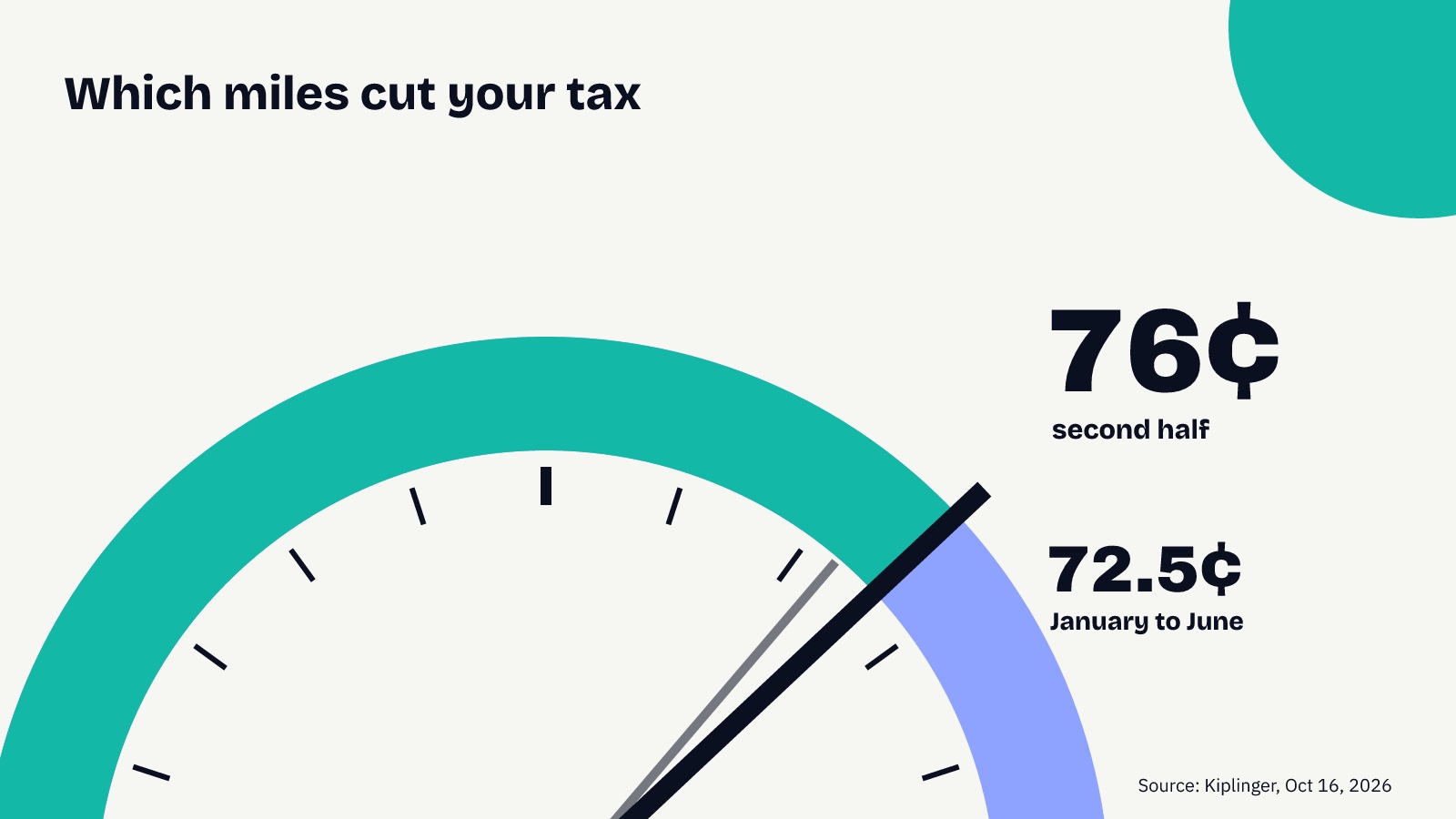
For 2026, Kiplinger reported that the business standard mileage rate is 72.5 cents per mile for January to June, then rises to 76 cents per mile for the second half of the year. If you use the standard rate, Taylor said you can also deduct tolls and parking fees you pay for business trips. Because the rate changed mid-year, your log needs dates, not just a single total, so each trip can be matched to the right rate.
For W-2 employees, the effect runs the other way. Unpaid work driving is a quiet pay cut. When you work out what your job really pays per hour, those miles belong on the cost side, just like an unpaid commute or unpaid training time.
Many people sit in both groups at once: a day job on a W-2 and a side gig on Schedule C. In that case, only the side gig miles can count, and only the ones that are truly for that business. Mixing the two in one log makes it harder to prove which is which.
Bigger vehicle purchases come with limits
The column also covered buying a vehicle for a self-employed business. Taylor said that a large pickup truck used 100% for a Schedule C business can have its full cost expensed under Section 179, a rule that lets a business write off equipment in the year it is bought. The catch is that the amount expensed this way cannot be more than what the business itself earns in taxable profit.
Bonus depreciation in the first year, another way to write off a large share of a purchase early, does not carry that income limit, according to Taylor. For passenger cars first put to business use in 2026 and claiming bonus depreciation, Kiplinger said new or used cars face a $20,300 first-year depreciation cap.
For a small side business, these rules matter mainly as a caution. The Section 179 limit means a big write-off is capped by what the business itself earns, and the $20,300 cap limits first-year depreciation on a passenger car. Check the details with a tax professional before you count on a vehicle write-off.
关于你自己的工资,可以问问这些问题
Before the year closes, a few questions can show where you stand.
- Which of my miles this year were commuting, and which were trips between work sites for my side business?
- Does my employer have a written mileage reimbursement policy, and have I asked about it?
- Is my mileage log dated by trip, so each one can be matched to the right rate for its half of the year?
- If I also hold a W-2 job, is my withholding there enough to cover the tax on my side income?
Taylor's advice on records was direct: "Be sure to keep a contemporaneous mileage log detailing each of your trips." Contemporaneous means written at the time, not rebuilt from memory in April. A simple note of date, start, end, purpose and miles is enough for most side earners, and a phone app works as well as a notebook.
接下来值得关注的
Before December wraps up, it makes sense to total your mileage log and gather receipts for tolls, parking and car costs while they are still easy to find. If the total shows your side business earned more than you expected, raising withholding at your W-2 job may still help cover the extra tax before the bill arrives.
Also check whether your employer has a reimbursement policy for driving, and ask before the year ends. Kiplinger noted that its answers are general information and that readers should talk to a tax or financial advisor about their own situation, which is worth doing if you bought a vehicle for your business this year or split your driving between a job and a gig.
本文在 AI 辅助下,根据“来源”中列出的报道撰写。数字、引语和来源在发布前均经过自动核查。
资料来源
- Kiplinger, 2026-10-16 kiplinger.com
- Pipwise Telegram channel, 2026-10-14 t.me
本文仅为一般性教育内容,不构成个人财务建议。计算示例中的数字均根据文中列明的假设计算得出,并非预测。
通过邮件获取下一篇指南
每周四收到 Payday Note,另送免费的 Raise Kit。