The U.S. Department of Labor has withdrawn three old opinion letters on how tipped workers in dual job roles should be paid, HR Dive reported, and confirmed a new tip credit proposal is coming. Here is which of your hours can be paid at the tipped wage.
What the Labor Department changed
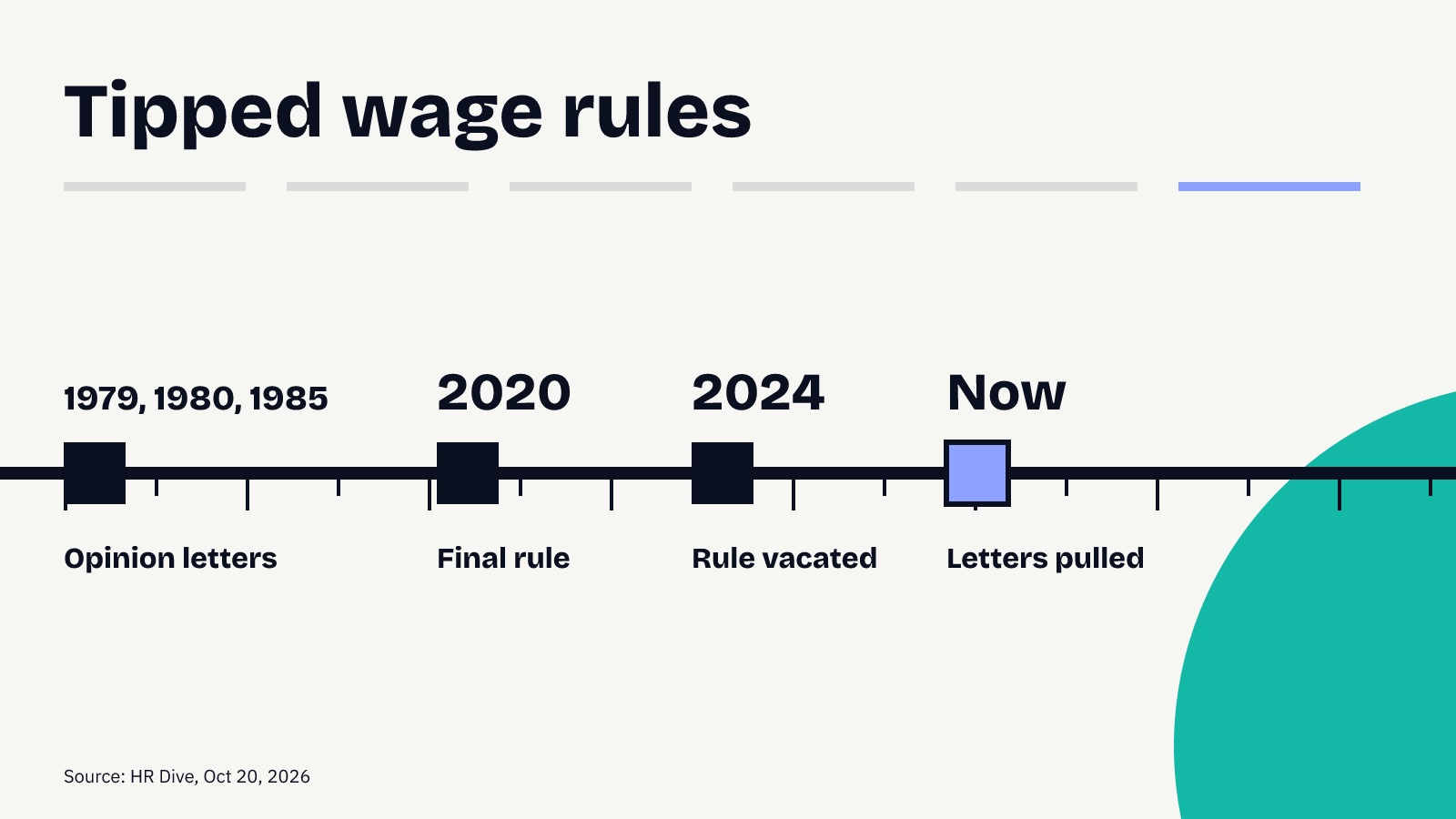
On Monday the Labor Department, often called DOL, pulled three opinion letters that dated from 1979, 1980, and 1985. According to HR Dive, the agency said the letters no longer match its reading of federal law and could be misread. DOL pointed out that the Biden administration had leaned on those letters, in part, when it brought back a time limit known as the 80/20 standard.
DOL also released a field assistance bulletin on when an employer may count your tips as a credit against the federal minimum wage. DOL said it will now look at whether a duty is related to your tipped job, with no percentage cap on time spent on related side work.
Tip credit and dual jobs, in plain English
A tip credit lets an employer pay a lower cash wage and count your tips toward the rest of the minimum wage. Under federal rules, the tipped minimum is $2.13 an hour. A dual job means you do two kinds of work for the same employer: work that earns tips, and work that does not.
Here is the key line. If you are in a dual job, the $2.13 rate can apply only to the hours you spend on tipped work. For your other hours, you must get at least the full applicable minimum wage. But there is a middle ground. Duties tied to a tipped job, like a server setting tables or making coffee, still count as part of that job. Those duties do not need the full minimum wage.
The fight over the years has been about how much of that related side work is too much. Under the old 80/20 rule, an employer lost the tip credit for related duties once they took up more than 20% of your time. With no percentage cap, that line would no longer be drawn by the clock alone.
Was das für Ihr Gehalt bedeutet
The money question is simple: which hours are paid at the tipped rate, and which at the full minimum wage? Related side work can be paid at the lower cash wage. Work unrelated to your tipped job should be paid at the full rate.
That makes your own records more useful than ever. If you track what you do on each shift, you can see whether non-tipped work is showing up at the right rate on your pay stub. Your state may also have its own wage rules, so it helps to know which ones apply where you work.
Fragen zu Ihrem eigenen Gehalt
A quick check before payday can show whether your hours are paid the way the rules describe.
- Does my pay stub show tipped hours and non-tipped hours separately?
- Which tasks do I do that earn no tips, and are any of them unrelated to my tipped job?
- Do my tips plus my cash wage reach at least the full minimum wage for my tipped hours?
- Does my employer pay the full minimum wage for hours that are not tipped work?
If an answer is unclear, ask payroll to walk you through it, and keep your own log of shifts and tasks.
Worauf Sie achten sollten
HR Dive described the move as the latest round in a back-and-forth between administrations. The first Trump administration went after the 80/20 rule with a 2018 opinion letter and then a 2020 final rule. That rule allowed a tip credit for related side work done at the same time as tipped work, or shortly before or after it. The Biden administration dropped it and restored 80/20, but a federal appeals court for the 5th Circuit vacated that rule in 2024.
A July regulatory agenda showed DOL had already started on a new proposal for dual job workers. On Monday the agency confirmed that plan and said it will take public comments once it is published. That is the moment to watch, because the final wording will decide where the line sits.
Mit KI-Unterstützung auf Grundlage der unter Quellen genannten Berichte verfasst. Zahlen, Zitate und Quellen werden vor der Veröffentlichung automatisch geprüft.
Quellen
- HR Dive, 2026-10-20 hrdive.com
Dieser Artikel dient der allgemeinen Information und ist keine persönliche Finanzberatung. Die Zahlen in den Rechenbeispielen ergeben sich aus den jeweils genannten Annahmen und sind keine Prognosen.
Den nächsten Ratgeber per E-Mail erhalten
Der Payday Note jeden Donnerstag, dazu das kostenlose Raise Kit.